
Big Picture Thinking 2.0
A Bolt of Energy for Paradigm Shift

As you know, most of my work over the past decade has been in service of advancing an emerging metamodern paradigm beyond the postmodern one that has for so long been hegemonic in intellectual circles and, increasingly, in popular culture as well. (Gosh, has it already been almost 12 years since that metamodern conference where I had my bathroom encounter with Francis Fukuyama? I guess History has been back for a while now…) What’s exciting, though, is that this journey has truly felt like an exponential explosion—one now going full-asymptotic with recent developments that I’d like to share with you (AKA, the focus of this Substack post).
In September of 2025 I came on full-time at the Institute of Applied Metatheory (quasi-tetragrammatonically, IAM for short), an “applied philosophy network” that applies proverbial Big Pictures (“meta-theories” [e.g., integral theory, critical realism, UTOK]) to the proverbial Big Problems (“meta-crisis” [e.g., ecological, geopolitical, meaning crises]) of our fledgling planetary culture. Well, the sheer intensity and scope of this investment of time and energy must explain and hopefully excuse my diminished output on other fronts (podcast, discussion forums, etc.), because, to put it simply, there are big things afoot at IAM, and I’ve been utterly engrossed in these profound and game-changing efforts. For the first time, I feel that metamodern ideas are getting the resourced, institutional support they need to actually make a real difference in the world, immediately as well as for decades to come.

It took me a minute to get up to speed on the leading-edge ideas this space has introduced me to (“what is metatheory…?” you likely ask, understandably anxious about this further proliferation of “meta-” prefixed terms in an already abstruse lexicon), but now that I have seen even more the “pattern that connects” and all its profound promise and urgency for our moment of breakdown, chaos, and seeming collapse, I recognize the power of what integrative metatheory has to offer.
If you want the TL;DR, the short version is essentially this:
Our way of seeing the world in (post)modern society has been deformed by deep ideological assumptions and blind-spots that fundamentally misframe ourselves, the world, and their relationship in ways that tend to reproduce destructive and degrading systems that are unethical, unsustainable, and unrealistic—the remediation of which requires stepping back to a broader, more encompassing vantage that can better encapsulate the big picture of reality for a truer, righter grip on what is actually going on. And only when we take reality for the complex, multi-layered, dynamic, processual, evolutionary-developmental, and relational phenomenon it is can we begin to gain the requisite clarity and vision to fashion systems that can take us to the back-half of a flourishing 21st century. Advancing our understanding of these, we can actually change the world for the better!
If that sounds cool, great!
If it sounds disappointingly simplistic and narrow-minded—too bad. You were the one who wanted the TL;DR short version! what’d you expect? Pff…
The longer, more complex version is…longer, and more complex. (But now you can’t fault me for that.) But let’s give a first pass to Nick Hedlund, one of my partners-in-IAM over at IAM. He and Sean Esbjorn-Hargens (the original coiners of the term ‘metacrisis’) write in their intro to Metatheory for the Twenty-First Century:
The twenty-first century is a radically new era, unprecedented in human geo-history, marked by deep and complexly interrelated global crises: ecological, economic, political, moral, and existential, to name but some of pertinence… Due to their profound interdependencies and feedback loops, these complex and intractable crises can best be understood as a singular socio-ecological crisis, or what we call the metacrisis. …In this context, comprehensive and sophisticated integrative frameworks are needed for three main reasons. First, complex twenty-first-century problems and the metacrisis at large demand frameworks that go beyond the proliferating fragmentation of knowledge and ‘grasp the big picture’; that is, support us to effectively account for the intricate multidimensionality and dynamism of the metacrisis, foster coordination and integration across disciplinary boundaries and knowledge domains, and ultimately help generate transformative praxis that can optimize the conditions for planetary flourishing. Second, integrative metatheory can serve a crucial emancipatory function by helping us to identify the real causes of social pathology, oppression, and alienation. Third, to resolve the metacrisis we need to expand the purview of our vision and imagination to develop ideas about what human beings are capable of and what are the conditions for their universal free flourishing; metatheory is well placed to assist with this by articulating an integrated descriptive, normative, and aesthetic vision of a concrete utopian, eudaimonic world and a coherent program for global transformation in the coming decades. Without such a vision we cannot even ‘see’ what kind of planetary society is possible.
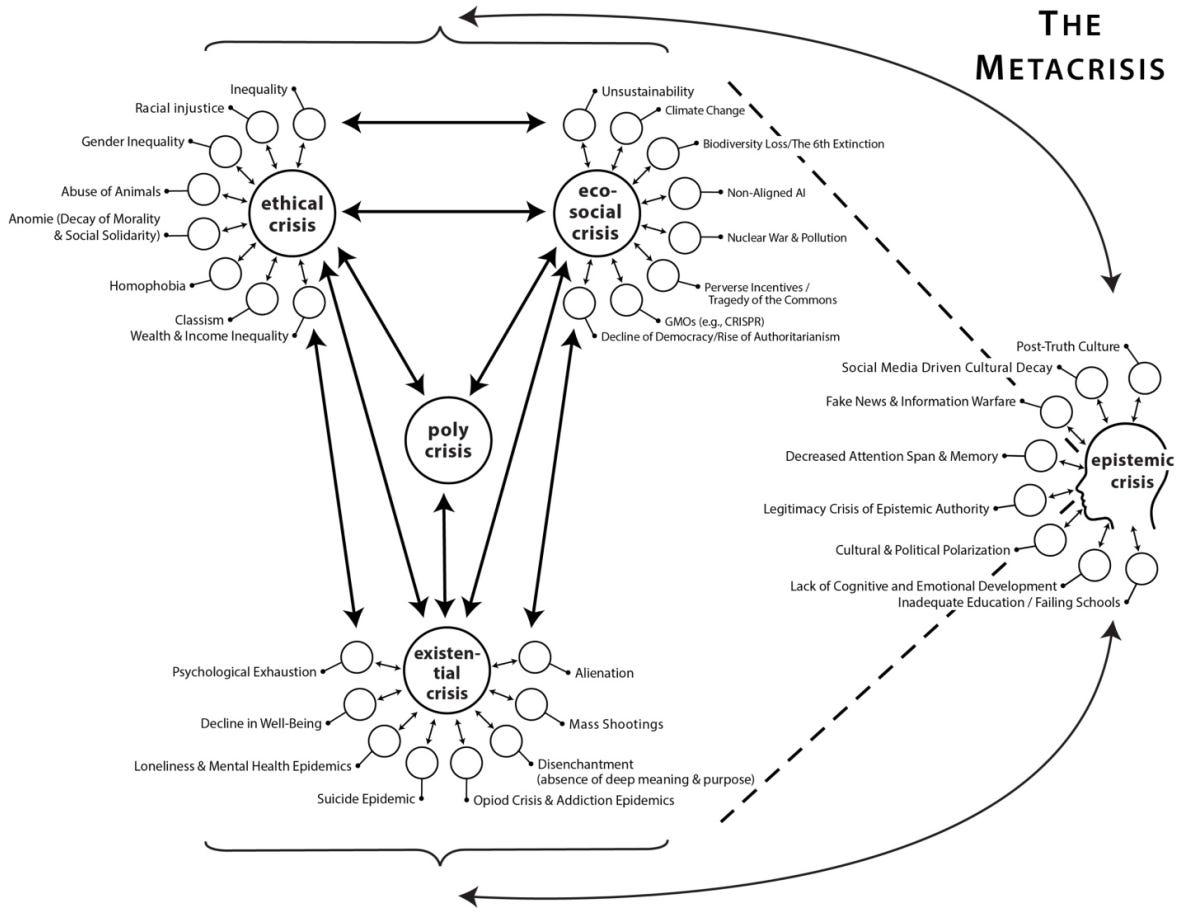
In short, big problems require big conceptual frames to make them tractable. If meta-crisis, then meta-theory.
Why? Because a big part of the problem is our own confusion about reality itself and the way we construe our knowledge of it. Today, knowledge is fractured, science and the humanities are at odds—and no one is able (or welcome) to put the pieces together—thanks in large part to postmodernism’s insistent “incredulity towards metanarratives.” Given the aforementioned hegemony of postmodernism, any attempt to tell any sort of Big Story has been paradigmatically suspect and derided for decades. (Never mind that postmodernism itself tells its own Big Story of the end of Big Stories…)
But here the connection to metamodernism becomes clear: Not anymore. The prospect of an “integrative metatheory 2.0” that lies beyond modern positivism’s earlier, half-baked gestures at some reductionist TOE offers the possibility of a properly metamodern and genuinely integrative take on the “Big Picture,” one that appreciates postmodernism’s totalizing critique without succumbing to its radical fragmentation and ouroboric self-consumption.
Does that make any sense?
If not (or if so), here’s a video that tells the story its own way:
Point is: Our whole way of understanding (ourselves, the world, and our relationship) is fractured into disconnected siloes and misframed half-truths. Bridging the siloes and wholeing the halves is the name of the game, and, interestingly, the way to do so is by appreciating a New Story that connects them into a coherent, integrated whole. Indeed, it seems to me that
the grand narrative of cosmic evolution points the the way to healing our epistemic fissure and uniting our understanding of self and world in a manner that can give us a grip on reality and the metacrisis!
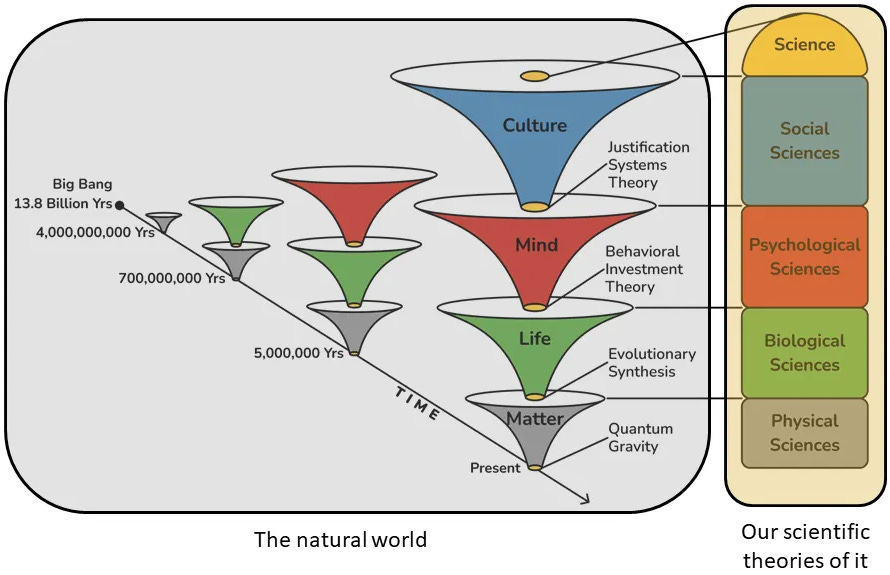
This is the thesis we’re working with at IAM, where we are endeavoring to take Big Picture thinking to a new place, for a new generation.
To this end, we’ve got a handful of exciting research vectors underway, working groups forming, and initiatives getting funded for their social impact potential. We’re interested in working with driven, highly productive people to not just talk the endless meta-talk but actually put rubber to road and world-changing and system-instantiating efforts into motion.
Most excitingly, we’ve started a new academic journal, Integration: The Journal of Big Picture Theory and Practice, as a scholarly home for “advancing the integrative study and applied use of metatheory and systems thinking for engaging with the unprecedented complexity of the 21st century.” If you’re interested in contributing to the consilience of knowledge, syncing up humanity’s Big Pictures into a more comprehensive framework, and/or applying such frameworks to real-world problems in emancipatory ways, we’d love to see your work in 2026!

I’ll leave it here for now, though there’s so much more to say, and I’ll be posting more about developments from IAM in the coming weeks and months. For now, if you’d like to stay up to date, here’s where you can find IAM across the social media landscape:
Facebook: https://www.facebook.com/appliedmetatheory
Substack: https://substack.com/@appliedmetatheory
X: https://x.com/IAMetatheory/
LinkedIn: https://www.linkedin.com/company/institute-of-applied-metatheory/
YouTube: https://www.youtube.com/@instituteofappliedmetatheory
There you can find recordings, podcasts, scholar bios and quotes, metatheory explainers, white papers, research findings, event invitations, and much else in the days and weeks to come, so stay tuned!