
How Meaning Grows
Where Evolution, Psychology, and Spirituality Converge

In my work, I’ve emphasized how cosmic evolution is a complexification process that unfolds through the learning of meaningful information by entities in context. Our main goal in this series, I said, was to track that process at the level of human Culture, where it unfolds through Symbolic Learning: the processing of meaningful information through symbolic language by egoic persons in societies.
As an information processing medium that inherently transcends individual minds, yet also organizes and constructs them, symbolic meaning is by nature multi-scalar. That is, Symbolic Learning is both an individual and a collective phenomenon, as all individual psyches are necessarily socialized through collective representations while collective representations are only ever instantiated (as well as actively reproduced and updated) through individual psyches. This volume has been dedicated to exploring what this process looks like at the level of the individual psyche (the next will examine it at the level of the collective society).
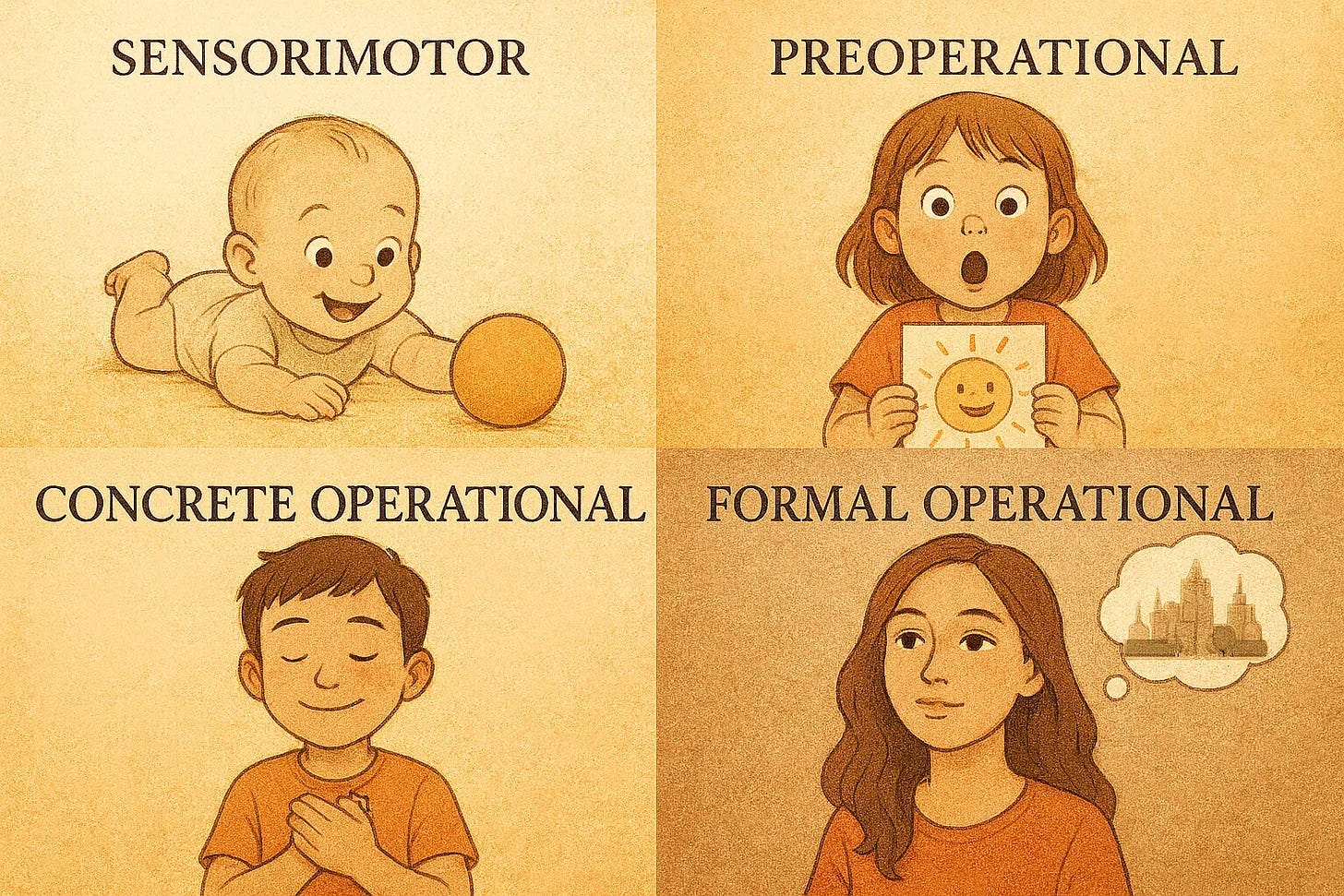
Ontogenetically, we have seen, Symbolic Learning emerges out of Cognitive Learning through a recursive complexification process. Through assimilation and accommodation, the early psyche learns to coordinate innate reflexes into more complex combinations, by means of which increasingly adaptive and successful action patterns are assembled. Learning such sensorimotor actions allows the (always goal-directed) psyche to better meet its needs.

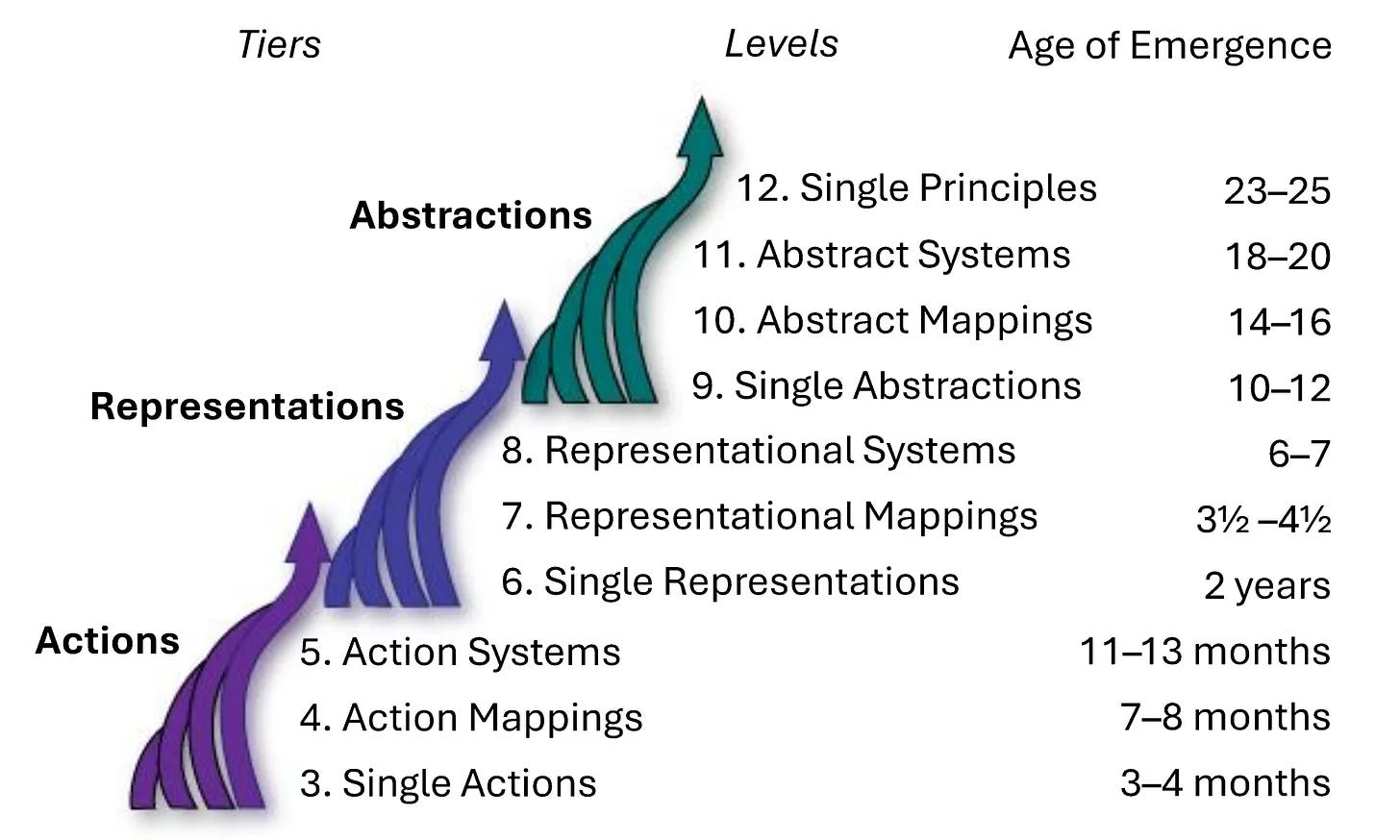
Unlike in other minded animals, though, by around 9 months the human psyche enters into joint attention-sharing cognizant of intersubjective goals and by 18 months begins to develop linguistically-mediated representations of complex action patterns. With this onset of the symbolic function, these representations can now themselves recursively complexify, and Symbolic Learning begins in earnest. So, from single mental representations conceptualizing certain systems of sensorimotor systems (Lectical Level 6), the goal-directed psyche discovers successively more adaptive states of equilibrium through the cognizance of representational relationships around 4-5 years old (Level 7), then entire systems of representational relationships around 5-7 years old (Level 8). As it does, the sorts of adaptive solutions discovered prove increasingly effective and reliable (e.g., the recognition of generalizable conservation dynamics). This, we saw, occurs through increasing information processing capacities coming online, allowing for more complex coordinations of mental attentional content.
At the same time, this increasing mental complexity is relentlessly rendering novel sorts of experiential phenomena intelligible. Hitherto unconceived aspects of reality enter the psyche’s field of attentional consciousness—bringing, necessarily, new orders of evaluative appraisal and consideration. How should the psyche respond to such newly intelligible phenomena? Broadly speaking, are they attractive or repulsive? Do they portend pleasure or pain? How should the (always goal-directed) psyche value these new knowledge contents? How are they meaningful to the self-in-context?[i]
Starting typically around age 9, the psyche, through further recursive complexification of mental contents, eventually comes to cognize whole systems of representational systems—that is, abstract concepts: general categories of ideas that can contain many similar kinds of complex concrete relationships as elements within a broad class (Level 9). As ever, this new cognitive capacity offers a way to organize the information of experience and help structure behavioral responses in an entropic world. That is, abstraction is hardly reserved for “purely logical” thinking (e.g., “‘conservation’ is the idea that the quantity of something remains the same despite a change in its appearance”), but pertains first and foremost to meaningful information bearing on biopsychosocial wellbeing (e.g., “Being foolish will get you into trouble”; “It’s taboo to sleep with your cousin”; “Keeping promises is the right thing to do”). In short, not just knowledge but meaningful knowledge becomes abstract, identifying different instances of adaptive and maladaptive behavior under broad categories—“chunking” the informational load of many particulars into a more computationally manageable signifier for more adaptive navigation of the environment.
From here, recursive complexification can continue as the psyche learns to identify relationships between such minimally abstract knowledge. So, through meaning-making at Level 10, one can acknowledge not merely that keeping promises “is right” but indeed truly important because “broken promises can harm relationships” and “if people keep promises then they can depend on each other”: that is, connections of abstract insights of an altogether deeper and more robust sort of meaning-making.[ii]

Indeed, as this example shows, making meaning at different levels represents qualitative shifts in justification. To ask someone who says that “Keeping promises is the right thing to do” (Level 9) the reasons why they think this, appeal can only be made to highly concrete phenomena (e.g., “people expect it,” “you feel bad if you break it,” etc.). By comparison, justifications at Level 10 include abstract-level sensemaking about the importance of relationships and human interdependence in its reason-giving.
As cognition continues to develop, justifications reach into higher orders of abstraction—which is to say, in generalizability and scope of applicability. So abstract relationships from Level 10 make up the ideational foundations for conceptually systemic justifications at Level 11. For instance, ideas like fairness, trustworthiness, honesty, etc. represent abstract building blocks from which a complex idea like “personal integrity” is built. A Level 11 justification for promise-keeping, then, might acknowledge both the need to “preserve one’s own personal integrity” as well as the fact that “keeping promises builds a sense of trust which keeps society functioning.”
By now, we are a far ways from simple, concrete, and particularistic reasoning, having progressed along the developmental spectrum towards more relational and generalizable forms of thought. In doing so, development of cognition and value through Symbolic Learning is marked by an expansion of the depth and scope of meaning-making. Indeed, as the last example indicates, this expansion is true both inwardly (i.e., deeper into the interior dynamics of the personal psyche) and outwardly (i.e., farther toward the highest levels of external causal dynamics). Cognizing notions of personal integrity and the functional necessities of society represent a “deepening” of the subject and a “widening” of the objective sphere of action. So, entering Level 12 and beyond, thought becomes more encompassing and comprehension itself becomes more comprehensive. As it does, values and goals broaden as the transjective sphere of action encompasses more mutual information potentially bearing on viability. Universal principles and concern spread to the very limits of the Universe.
In Volume 1, I cited a version of this dynamic as it plays out in Cognitive Learning processes. Developmental biologist Michael Levin, for instance, has coined the term “cognitive light cone” to describe the variable spatiotemporal horizon of a cognitive entity’s meaning space—what John Vervaeke would call the “salience landscape” of its agent–arena relationship. As Levin puts it:
The cognitive boundary of an Individual is the most distant (in time and space) set of events that this system can measure and attempts to regulate in its goal-directed activity. It is a surface indicating what things this system can possibly care about (conversely, it defines preferences as the spatio-temporal domain of states that serve as inputs and outputs to the system). In advanced agents, it is also the boundary of the self-model.[iii]
Figure 2.8. Expanding Levels of an Entity’s Cognitive Light Cone[iv]
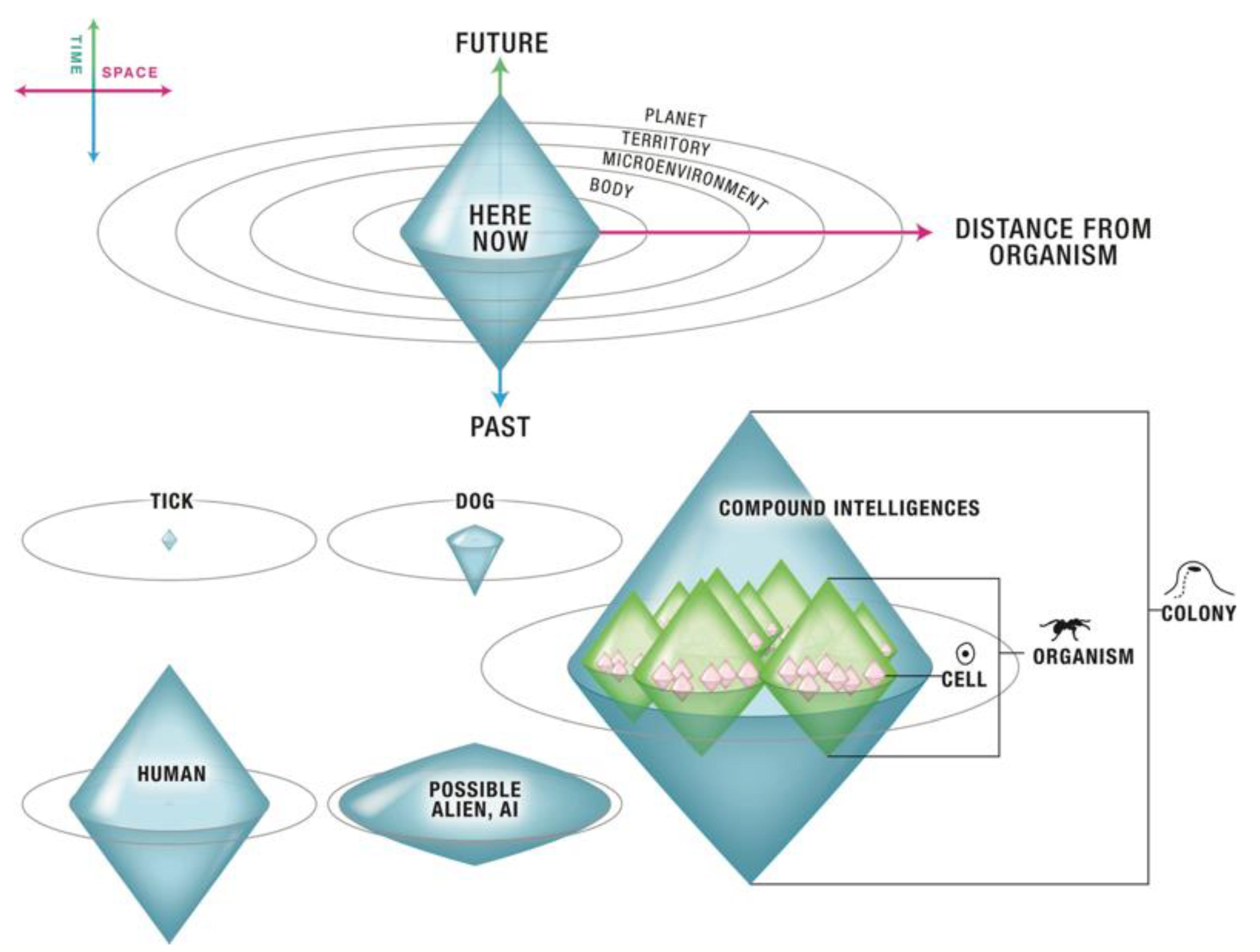
More expansive cognitive light cones are available to more complex organisms owing to the level of information they are able to process. A dog cognizes and so can (and must) care about more than a tick; a human even more so. Evolutionary pressures drive animals engaged in Cognitive Learning to push the limits of their knowledge about their environment—and themselves. As their knowledge expands, so does their Umwelt’s sphere of meaning-making.
The same dynamics characterize Symbolic Learning specifically, where linguistically-mediated conceptual knowledge processed by human psyches offers novel ways of extending the horizon of the transjective agent–arena relationship. Indeed, to his credit, Piaget himself recognized some form of this many decades ago. In his 1976 book Behavior and Evolution, for instance, he refers to “the extending of the environment” as “the most general aim of behavior.” Appreciating the human psyche as an open system far from thermodynamic equilibrium, he writes:
Every organism constitutes an open system in Bertalanffy’s sense; its self-conservation depends on constant exchange with the environment in respect to the needs for nutrition and for protection against predators. Any such system is permanently threatened by its limitations and, even where the environment of the moment can meet immediate needs, the development of the most primitive precautionary and anticipatory behavior will eventually expand it. …[T]he environment is extended as a knowable if not immediately utilizable one. …This process, which may be identified in animals whose organization is of the most primitive kind, is naturally reinforced as soon as simple precautionary behavior gives way to the curiosity of the higher vertebrates, and even more so when actions become susceptible of ideational internalization and the door is opened to the indefinite expansion of the need for knowledge characteristic of human thought.[v]
Simulated internal world models, we saw, were a huge advance by Minded animals, who could Cognitively Learn ontogenetically at a pace that far outstripped the Genetic Learning rate of the species. Subjective experience offered a novel way to internally represent the environment through neuronal processing, instead of relying on evolution’s representational encoding of the environment in the genome through genetic variation and natural selection.
With Symbolic Learning, the process got another update, as now “ideational internalization” could probe reality further and more fully than any mere physical encounter.
Abstract thought advances over the concrete, exponentially expanding the capacity of the psyche to cognize—and so care about—exponentially more of reality.
Through language, Symbolic Learning hit on a way of rendering more of the environment “knowable if not immediately utilizable”—a developmental process that has taken curious Homo sapiens from the deserts of Africa to the deserts of Mars in but a blink of geological time. Quite a substantial widening of the objective sphere of concern! But just as if not more importantly, it has also occasioned the profound deepening of the subjective human psyche—from primate-level egocentric absorption to scientific- and indeed spiritual-level sensitivities to the fundamental inter-connectedness of all things.

Indeed, Levin recognizes the moral and even spiritual resonances of this observation for the expanding nature of human meaning-making, musing:
Presumably, the volume of possible cognitive light cones keeps expanding with evolutionary time… Over evolutionary scales, there have been “inflationary leaps” – innovations in body structure which drastically increase the cognitive boundary of viable selves. The formalism places no upper bound on the size of the cognitive light cone. Thus … it is important to also consider “increased capacity”: what would a being with a much larger cognitive boundary than a typical Homo sapiens be like? It is interesting to consider whether this is the sort of outcome envisaged in classical traditions that posited evolution of human consciousness to a state of “Buddhahood” – a cognitive boundary so large that such an individual would be capable of, for example, being directly concerned about the individual welfare of a myriad of beings.[vi]

Ken Wilber drew a similar sort of conclusion a couple of decades earlier. Considering evolution’s expanding levels of consciousness in constructivist-developmental terms, he observed that
